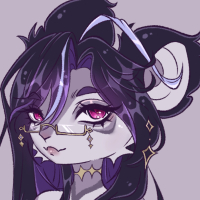
⋆˙⟡A Minkis Manors story of Asphodel⋆˙⟡
A Minkis Manors story of Asphodel
Chapter One: The Heretic's Sentence
Doctor Asphodel Sergeyevich had spent the better part of his life convinced that death was nothing more than a flaw in the design of the world, an error of craftsmanship that a sufficiently stubborn mind might one day correct. It was an opinion that had won him a great many enemies, and the laboratory in which he pursued it had won him a great many more.
The laboratory lay beneath the oldest quarter of the city, a vaulted chamber so wide that its far wall dissolved into shadow, where brass machinery crawled between the stone pillars and glass cylinders breathed out a pale green light. On the night the soldiers came, Asphodel was bent over a worktable buried in diagrams, his fingers stained black to the knuckle with ink, studying the thing he had built across eleven years of sleepless obsession: a mechanical heart no larger than a plum, its silver gears turning behind a window of glass, a tiny hand circling a face of engraved numerals.
Along the far wall stood rows of iron cages holding everything that had come before it, rats and hares and a lone fox that no longer moved, though something in its chest still ticked on. Asphodel had numbered every one of them and named none. He hummed as he worked, a slow lullaby his mother had once sung, and when a cage rattled with a thin, desperate scrabbling, he did not so much as glance up.
"Patience," he murmured, with no warmth at all. "You will have your turn, and you will be of use." Every tick of the new heart sent a shimmer of magic through the casing, and every shimmer made him smile a little wider, because it was the first one that had not faltered.
He was still smiling when the door burst inward, and he went on smiling as boots thundered over the flagstones and lantern light swept across the machines and a ring of soldiers closed around him with their swords drawn, but he had no reaction, which unsettled them far more than any shouting or pleading would have done.
Asphodel straightened and sighed, the way a man sighs when a servant interrupts his supper.
"Doctor Asphodel Sergeyevich," said the captain, "by order of the Crown and the Arcane Court, you are under arrest for forbidden experimentation."
"Would you mind waiting until I have finished this equation? I am so close I can feel it."
"Your days are over," the captain said. "You will never carry out your sick experiments again."
"Then you are nothing but an idiot," Asphodel said, "and I refuse to be arrested by someone so inept."
He tilted his head and looked the captain slowly up and down, the way a butcher studies a carcass. "Such a strong chest," he added softly. "Such a steady heart. I was running short of subjects, you know, and here you are, delivered to my very door."
The captain's hand shook on his sword, and Asphodel, noticing, laughed. Then he fought them, with a savagery that frightened even the veterans among them. A chair left his hands and shattered against a pillar, a rack of glassware followed it, and when one unfortunate soldier came within reach, Asphodel drove a shard of glass into his forearm and watched the blood well up with an interest that had nothing to do with anger.
There were a dozen of them and only one of him, however, when a binding spell finally closed around his wrists in cold silver chains, he stood panting among the wreckage with his spectacles hanging from one ear, furious less at being caught than at being interrupted.
Behind him the little heart went on ticking. They took that as evidence of his outlandish experiments.
The trial lasted three days, and Asphodel despised every hour of it. The Arcane Court gathered in a vast amphitheatre of whispering robes, row upon row of judges and nobles and learned men looking down at him as though he were some beast that had wandered in from the marshes, and he met their stares with the placid calm of a man who knew himself to be the cleverest creature in the room, studying each face in turn as if deciding what it would look like opened.
They accused him of heresy, and he called it medicine. They read out the inventory of the cages, the hares and the dogs and the fox, and then the names of two paupers who had taken his coin and were never seen again, and he answered that they had volunteered, in the sense that they were hungry, and that every cure in history had been bought with someone's suffering.
When at last an elderly magistrate asked whether he felt any remorse, Asphodel laughed aloud, and the sound carried to the very top of the chamber.
"None," he said, almost gently. "I have watched children waste away from fevers that should never have existed while your priests murmured about destiny, and you call me the dangerous one because I refused to kneel to it. Bury me if you like. You will only prove that you are afraid." His gaze drifted to a pale councillor in the front tier and lingered there, pleasantly. "Though do remember who you sent away, when your own hearts begin to fail. I shall be thinking of you all."
The chamber fell silent, though not from shame; a woman in the gallery crossed herself, and the councillor he had singled out had gone the color of tallow.
Then the lead judge rose, and there was something in the old man's calm that made the back of Asphodel's neck go cold.
"Doctor Sergeyevich has spent his life dissecting the small and the helpless in pursuit of his creed," the judge said. "This Court finds it fitting that he should learn their lot for himself."
Light blazed up from the runes beneath his feet, and Asphodel understood a heartbeat too late. He fought the spell with everything he possessed, with every counter-incantation he knew and a few he invented on the spot, snarling through his teeth as his bones folded in upon themselves and the courtroom lurched upward around him, and the last thing he heard as a man was his own voice cursing the judges one by one.
When the glare faded, a small teal grey mouse sat trembling on the stone, and hundreds of faces looked down at him from above, and not one of them was afraid any longer.
They sealed him in a glass jar and carried him for days along a road he could not see. He bit the fingers of every guard who handled him, hurled himself against the glass until his skull rang, and screamed threats that nobody could understand.
At last the lid was lifted in the depths of a forest, a hand tipped the jar, and he tumbled into the leaf litter while the soldiers' footsteps faded without so much as a word of farewell.
The forest taught him humility more thoroughly than the Court ever could have. Owls dropped out of the dark, foxes ran him through brambles until his lungs burned, and a single night of rain turned a ditch into a river that very nearly drowned him. He ate beetles and half-rotted acorns, slept in the hollow of a root with his teeth chattering, and in the quiet hours he still composed furious speeches for an audience of no one, because the alternative was to admit how frightened he was.
It was in the third week, or perhaps the fourth, that he saw lights between the trees: a vast house of pale stone with every window glowing gold, music drifting from its open balconies, and over every wall a tumbling curtain of blue wisteria whose sweet, strange scent reached him long before the house itself did. At the foot of the garden wall a crack ran through the foundation, too narrow for a fox and just wide enough for a mouse. Asphodel hesitated for only a moment. Then he squeezed through into the warmth, not knowing that the house he had chosen was Lockheart Manor, nor how little time it had left.
Chapter Two: The Clock in the Chest
Lockheart Manor was, Asphodel decided within a week, the only place in the world that had ever shown a mouse kindness by accident. The ballroom floor was strewn with crumbs after every gala, the kitchens leaked warmth through the walls, and the library offered a hollow behind a row of unread botanical volumes, small as a teacup and easily lined with scraps of stolen velvet. He made it his home.
He still thought in long, tangled, elaborate sentences, still rehearsed his arguments against the Court while he nibbled cake, and whenever a housemaid's broom swept too near his hiding place he bared his teeth with a fury far too large for his body, though he took great care that nobody ever saw it.
The cats were the manor's real masters, and he gave them a wide berth. There were dozens of them, draped across the grand piano or dozing in the rafters, fat on cream and tied up in lace ribbons for the amusement of the guests, but the one he could not avoid was the largest of them all, a lordly creature who wandered into the library at odd hours with the air of someone merely passing through a house that belonged to other people.
The servants called him Bartholomew, and they went quiet when he walked by. He never seemed to notice them. He seemed, rather, to notice everything, and one evening his gaze settled on the gap behind the botany books where a pair of small eyes was shining.
"A mouse," Bartholomew observed, in a voice as smooth and lazy as warm oil. "In the library, of all places. I do hope you can read."
Asphodel said nothing. He pressed himself into the velvet and glared with all the dignity a creature of four inches could muster, and after a long moment the cat yawned, stretched, and left him alone.
It was the first conversation anyone had offered him in months, and he found that he resented it deeply.
Then came the last gala. He watched it from the shadow of the library door, as he had watched all the others, but this one felt different from the start. The laughter had a brittle edge, the champagne went down unfinished, and the guests kept glancing toward the windows, where letters sealed in crimson wax had been arriving at all hours.
At the heart of the ballroom stood Lady Elara Ravenscroft beneath her blue wisteria, and when the guests raised their glasses in a final toast, she lifted her own and spoke a word that Asphodel, who had memorised half the spells of the age, had never heard in his life.
A thick blue Mist rose from the gardens and rolled over the windows like a tide. The music stopped in the middle of a note. The glasses hung in the air for an instant, bright and full, and then every guest, every servant and Lady Elara herself were simply gone, leaving only the lingering scent of wisteria and a silence so complete that Asphodel could hear his own breathing.
The pain struck an instant later. It tore through his chest like a hot wire, and he fell to the floorboards gasping as something sharp pushed outward from beneath his ribs, a long brass key, which hung there for one terrible moment before sliding slowly into the small of his back. Then came the ticking. It started faintly and grew louder until it filled his skull: tick, and a long pause, and tick again. His heart had turned to metal, and it was wrong.
He could feel that it was wrong, as surely as a physician feels a broken bone, because the gears had formed unevenly and the beat dragged far behind where it should have been.
He lay there for a very long time. The fury that had carried him through the forest drained out of him by degrees, until only a heavy, aching tiredness remained, and for the first week he could barely lift his head.
When he finally did, the manor had changed. The clocks did not move. The candles burned without shrinking. Pale shapes drifted along the corridors that looked like spiret cats and when he watched them from the stairs they flickered and turned their heads toward him with mild, forgetful eyes, then wandered away. He did not speak to them. He did not speak to anyone.
Only Bartholomew still came to the library. He found Asphodel one evening sitting against a bookend, slow and grey with fatigue, and studied him for a while with his tail curling.
"You are still alive," the cat said. "How disappointing. I had rather hoped the clock would finish you."
Asphodel looked up. His own voice, when it came, was flat and slow. "I'm sorry to disappoint you."
"Don't apologise. It is the most entertaining thing anyone has said to me all week." Bartholomew lowered himself onto the carpet. "Do you plan to haunt my library for the rest of eternity?"
"It isn't your library."
"Nothing here is anyone's anymore. I merely visit." The cat's eyes narrowed with amusement. "Do try to remain interesting, little doctor. I would hate to start missing you."
Asphodel did not answer, and Bartholomew left as unhurriedly as he had come. But it was the first time in a very long while that anyone had called him by what he was, and he sat for a long time afterward listening to his slow heart tick in the silence, wondering why it had sounded, for just a moment, a little less lonely.
In time, others began to appear. Small, ticking creatures stumbled out of the walls with clocks beating in their chests, bewildered and frightened and alive, and Asphodel watched them from the dark between the shelves as they gathered, quarrelled, and slowly began to build. They hung lamps. They set out benches. They turned the quiet corner of the library into a little street, and he lingered at its edge, unseen, and told himself that he did not care.
Chapter Three: First Encounters
It was well known throughout the manor that a tired old minki who could mend clocks had set up in a nook of the library. You could hardly call it a clinic; it was closer to a cluttered bin where a minki might bring a stuttering clock heart to be looked at, and Asphodel never troubled himself to correct anyone. He spent his days buried in research, but the hunger that had once driven him toward eternal life was gone, and all he truly wanted now was something interesting enough to fill the hollow space inside his slow, ticking heart.
A loud thump echoed from the front of the clinic.
"Did that stack of papers fall over again..." he muttered, shuffling out in expectation of a drift of scattered notes. Instead he found a minki standing stiff as stone in the doorway, frozen mid-step with one hand still half raised.
He circled the purple mouse once, then twice. He poked its ribs, then its ear, and finally, in rising irritation, its nose. Nothing moved. Not so much as a flicker of an eyelash. At last he found a small letter tied to the minki's tail, and he tore it open and read.
Dear sir, we have been told that you fix things. We found this minki like this and do not know what is wrong with him, so we decided to bring him to you.
"What an irresponsible bunch," Asphodel said, furrowing his brow and rubbing his ears. "Could they not at least have told me in person?" He glared at the statue. "Well, I suppose I have no choice. Otherwise I will be stuck with a statue in my clinic for the rest of eternity."
It took him a very long time. He pushed and pulled, and rested, and pushed again, until at last the frozen minki stood inside the back examination room and Asphodel collapsed on the floor, breathless, glaring up at his new burden. Then he noticed something, and the glare faded.
"Why don't you have a key?"
He went digging through his notes on what it meant to be a minki. "Hmmmm. Normal anatomy dictates a minki has a wind-up key. A malformation, perhaps, or a defect. How odd." The hours slipped by. He tried key after key, and even molded one of his own, but nothing worked. Again and again he leaned in to listen at the clock heart, and each time it gave him nothing but silence. Finally, with no options left, he made a decision he knew he would regret.
"Oh, he is going to have such a big head when I ask him for help."
He waited until night fell, because he had no wish to meet any other minki, and crept down to the grandfather clock to wait. Somewhere in the long dark he must have dozed off, because the next thing he knew a black tail was flicking him awake.
"Oh, how interesting. The old man has come to visit me," said a voice, sarcasm dripping from every word.
"Yes. This old man has." Asphodel rubbed his eyes, speaking plainly. "I... I have a situation."
Bartholomew lowered himself down and folded his paws, delighted at the sight of Asphodel searching for a way to ask a question without truly asking it.
"Oh, spit it out already," he said impatiently, flicking his tail to nudge Asphodel along.
"Fine. I need your help," Asphodel said, much more quietly.
"Oh? What was that? I didn't hear you." He smirked. He had heard every word, and he absolutely wanted it again.
"I need your help!"
"There is no need to shout." Bartholomew laughed softly, savouring the annoyance on Asphodel's face.
"So tell me, Asphodel. What do you need my help with?"
Asphodel pulled out a bundle of crumpled diagrams of minki anatomy. "Why would a minki be frozen still? I have tried keys. I have even molded my own, and nothing." A little of his old self cracked through his voice, impatient and sharp with anger, and Bartholomew raised an eyebrow.
"If you must know, a minki's key is crucial to its existence. Each of you was given one key, and only that one is capable of giving you life." He watched Asphodel pondering and scribbling.
"So you are saying this minki can only be unfrozen when its original key is found and put back..."
"Exactly! Aren't you clever?" Bartholomew rose and left without another word, and Asphodel was alone again.
"Wonderful," he said to the empty darkness. "Now I have to find one key in this godforsaken, massive mansion."
The night swept on. Moonlight glittered across the library, the books lay silent, and the grandfather clock chimed midnight. The manor held countless rooms and nooks, and the curtains swayed while dust motes danced in the pale light. In the middle of it all, a single small lamp burned in the clinic. Asphodel had already mapped part of the library, partly out of the need to research and partly out of the need for sanity, because his mind was still human while his body was so small that his mind could scarcely grasp it.
For weeks he wandered out each night, mapping more and more of the library and hoping the key had been lost here and not in some other room. He searched through books and examined every shelf, climbed desks and opened every little compartment. And after two weeks, tucked behind a green philosophy tome, he found it: a silver key with purple accents, the same shade as the minkis themselves, shaped like a crescent. He tied it tightly to his back and hurried to the clinic.
In the examination room he moved the minki's long black hair aside and placed the key. It fit perfectly. He wound it once, then twice, and on the third turn he heard it, the familiar tick of a clock.
Slowly the minki began to move, first a finger, then a hand, and before Asphodel knew it the minki who had stood frozen before him was breathing and speaking.
"I'm... I'm not frozen anymore," he whispered, turning his hands in front of his face.
Asphodel sat down with a tired huff. He had done it. He reached for more paper. "Let us run an examination to make sure everything is in working order."
He guided the somewhat confused minki to the examination table, listening closely to the ticking of the clock heart.
"Thank you for helping me."
"Do not thank me. I am only doing my job," Asphodel said bluntly, refusing to meet his eyes.
"Even frozen, I could hear you pondering and talking aloud. I do not believe this was only your job. After all, hearing you hype yourself up to speak to Bartholomew had me thoroughly entertained."
Asphodel's face went completely red. His ears burned, and he sat down and buried his head in his hands, hair falling over his fingers and his tail tapping the floor every few seconds.
The minki gently took his hand.
"Truly, Doctor Asphodel, I am forever grateful for all the time and effort you put into saving me."
The minki smiled. And for the first time, Asphodel truly looked at him: the vivid raspberry-pink eyes, the dark purple strands woven through his black hair. He was, undeniably, beautiful. Asphodel's heart ticked twice in a row.
"Oh, my, I have not introduced myself. My name is Hyroptatyr. A pleasure."
He carried an air of sophistication, that of a scholar, and it reminded Asphodel of the professors at the academy, so well spoken that Asphodel wondered whether he, too, might once have been human.
"I am Asphodel Sergeyevich Zandik."
"That is quite a long name."
And in that moment Asphodel realised that the concept of last names would not exist among the minkis.
"No. My name is Asphodel. My middle name is Sergeyevich, and my last name is Zandik."
Hyroptatyr looked confused at the idea of anything beyond a single name. "Why would one need a middle name, or a last? And how would I get one?"
Asphodel scratched his head, stumped at how to explain family names. "Well, if there were more of us, minkis might start sharing names, and you would get confused. So you make a family name to show which family you come from, and who you are."
Hyroptatyr thought, and a light kindled in his eyes. "So I could be Hyroptatyr Sergeyevich Zandik? That does sound nice."
Asphodel blushed. "...Usually, taking someone's last name means you are married."
Hyroptatyr's face turned a soft pink at the thought of being someone's spouse, and he began to twirl his hair. Then he stepped quickly forward and kissed Asphodel on the cheek.
"Well, I suppose I will just have to find a way to become a Zandik." He gave a gentle smile and went on his way.
Asphodel stood there pressing his hand to his cheek. For once his heart ticked fast, and a feeling he had never known rose through him. He could not tell whether he was getting sick, only that his stomach felt strange, his chest was tight, his breath came shallowly and his ears burned.
"Perhaps I am coming down with a fever."
He lay down on the examination table and tried to sleep, but he kept twisting and turning, unable to stop thinking about Hyroptatyr. The matchbox beneath him felt too hard and the lantern light too bright. His mind was racing, though not in the way his research had ever made it race. After hours of shifting and rolling, he fell asleep.
During the day he worked, but every time footsteps sounded at the front of the clinic he jumped and hid, anxious and terrified of what to say if it was Hyroptatyr. He fidgeted with his tools and stared at his pots.
"Ahhhhh, why can't I just work?" he groaned, ruffling his hair and slapping his own cheeks. He stormed out of the clinic. It was already dark, and a familiar furry face waited outside.
"Oh, Asphodel. You are not dead."
"No, Bartholomew. I am not."
Bartholomew looked at him, a little annoyed that Asphodel had not brought any trinkets of late, and pouted.
"Well, then. What has kept you away so long?"
"It is stupid. You would laugh if you knew."
Bartholomew's eyes widened, and he lowered his big fluffy head to Asphodel's level. "Oh, now I am curious. Come, do tell. You owe me some entertainment."
"My feelings are not meant for your entertainment," Asphodel said, turning his back.
Bartholomew reached out one big paw and turned him around again. "I will not tell a soul. No minki or spirit cat will know. Not even the small dust petals of the manor."
Reluctantly, Asphodel told him about the strange feelings in his stomach and how he felt sick. Bartholomew's tail flicked with delight as he listened to Asphodel describe his symptoms.
"Oh, my dear friend. You are in love. How can you not know?"
"Me? In love? As if..."
Bartholomew patted him on the back and laughed at how the brilliant Doctor Asphodel had no idea what love was. Behind them, the grandfather clock chimed.
"How do I make it stop?"
"You do not wish to feel love? Oh, how preposterous. We all crave some kind of love, whether companionship or romance." He flicked his tail across Asphodel's head to scold him for the absurd question.
"Then how do I make it hurt less? I can barely think or work."
"Ha! Do not worry, my friend. I, the illustrious Bartholomew, shall help you."
Asphodel said nothing, but his expression made it clear that he doubted this would end well. Yet what else could he do?
Bartholomew pranced out of the library, and once more it fell dark and silent. But Asphodel's feelings were louder than any grandfather clock's bell. The moonlight did not seem as bright as usual, and everything felt more balanced. He felt more at ease in this minky body than he ever had before, and even the curtains that usually bothered him did not cross his mind. Perhaps, just perhaps, this life was not so bad. He sighed, slowly dimmed the last of the lanterns, and the library fell fully dark, with only a little moonlight bouncing off the glass and the spines of the books.
Chapter Four: Sparks of Love
Hyroptatyr had read the same page eleven times.
He sat curled in the corner of a reading nook with a battered romance novel open on his knees, a tale of a heartbroken captain and a lighthouse keeper that he had found beneath a shelf of old almanacs, and for the first time in his new, ticking life he understood why people sighed over such things.
The hero of the story was gruff and brave, and he always said the wrong thing before saying the right one. Hyroptatyr snapped the book shut, pressed it against his chest, and let his tail curl around his ankles.
"A shining hero," he whispered to the empty shelves. "Who stays up for weeks to find one small silver key in this maze of a library."
He had not forgotten a single moment of it. He remembered the way the doctor had sat on the floor, out of breath and glaring, and the way he had stammered through his own embarrassment with his ears burning red. Every night since, Hyroptatyr had lain awake listening to his own heart and wondering whether the doctor was lying awake too. He had kissed him on the cheek, which was terribly forward of him. He had not regretted it for a single second.
"Oh, you are hopeless," he told himself, laughing quietly into the cover of the book.
A black shape slid out of the shadows between the shelves, and a pair of amber blue eyes settled on him with great interest.
"Talking to books now, are we?" said Bartholomew. "That is the first sign."
Hyroptatyr jumped so hard that the novel tumbled out of his arms. "Lord Bartholomew! I did not hear you."
"One never does. It is part of my charm." The cat stretched elaborately and sat, curling his tail around his paws. "I have been watching you for several days. You sigh a great deal, you drop things, and you have walked past a certain clinic exactly nine times without going inside. I am nothing if not observant."
Hyroptatyr's face turned the colour of his eyes. "I only wished to thank him properly."
"Of course you did." Bartholomew's whiskers twitched. "Listen carefully, little scholar, because I do not repeat myself. Tomorrow evening, when the clock strikes eight, you will go to the old conservatory at the end of the east corridor and you will wait beneath the wisteria. Wear something nice. Do not ask questions."
"But why?"
"Because I have decided it," Bartholomew said, with the air of a monarch announcing a decree. "And because I am bored."
He left, tail high, and Hyroptatyr sat in the quiet with his heart ticking so fast that he had to pick up the novel again just to give his hands something to hold.
Asphodel, meanwhile, was having the worst afternoon of his entire second life.
He had tried to work and failed. He had tried to read and failed. He had reorganised his instruments three times, alphabetically, then by size, then by how much he disliked them, and now he stood in the middle of the clinic holding a tiny screwdriver and glaring at nothing.
"Doctor Asphodel!"
The voice rang out so suddenly that he dropped the screwdriver. Bartholomew was sitting in the doorway of the clinic, looking quite pleased with himself.
"There is an emergency," the cat announced gravely. "A patient is in distress in the east conservatory. You must come at once, at eight o'clock sharp, and you must bring nothing. No bag. No instruments. It is a delicate case."
Asphodel frowned. "Nothing? How am I supposed to treat a patient without tools?"
"With your hands, doctor. And your charm."
"I do not have any charm." Asphodel said in his usual flat voice.
"Which is precisely why it is an emergency." Bartholomew turned and swished out of the clinic. "Eight o'clock! And do comb your hair, you look like a startled hedge."
Asphodel stood very still. He knew, in the way that a man knows when the floor is about to give way, that he was being tricked. But some small, foolish, hopeful part of him whispered that he might even be glad of it, and in the end it was that part that made him go to the mirror, scowl at the startled hedge, and comb his hair to look somewhat less frantic.
He arrived at the conservatory at five minutes to eight with his hands empty and his heart ticking in his ears. And then he stopped, because the evening was so beautiful that for a moment he forgot to breathe.
The conservatory had been transformed. Wisteria hung from the glass ceiling in great blue cascades, and thousands of petals drifted down through the lamplight like slow, glowing snow. Someone had set out a table no bigger than a saucer, covered with a lace cloth and lit by a single candle stub that had been stuck in a thimble. There were two thimble-cups, a plate of crumbs arranged in a pattern that was either art or an attempt at art, and, floating translucently beside the table with a napkin draped over one arm, the spirit of a very old cat named Barnaby.
"Good evening, gentle minkis," He said the spirit, in a voice like wind through a keyhole and with a hint of grumpiness. "I am to be your waiter. Do not ask my why I ow Bartholomew a favour"
And under the wisteria, with petals caught in his dark hair, stood Hyroptatyr.
He had dressed in a small waistcoat of deep plum, and he was holding a single wisteria blossom in both hands as though he did not know what to do with it. When he saw Asphodel, his whole face lit up, and then, immediately, he looked like he wanted to disappear.
"Doctor," he said. "I... I was told there was an emergency."
"So was I," said Asphodel.
"There is no emergency, is there."
"I believe there is not."
They stood three feet apart, staring at the ground. Somewhere in the vines above them, Asphodel was fairly sure he heard a muffled snort.
"I shall kill him," he muttered.
"He did go to a great deal of effort," Hyroptatyr offered timidly.
Asphodel looked at the table and the candle in the thimble and the spirit waiter, who was attempting to smile, with enormous concentration he tried pour a thimbleful of cold tea. He felt the corner of his mouth twitch.
“This better be worth it Bartholomew.” Barnaby snareld at the rafters.
They sat. It was dreadful.
Asphodel asked whether the key had been giving any trouble. Hyroptatyr said it had not. Asphodel asked whether he had experienced any stiffness, any slowing, any irregularity in the ticking. Hyroptatyr said no, and then, after a pause, that his heart had been beating rather fast lately, which Asphodel immediately seized upon with relief, asking about the frequency and the duration and whether it occurred more in the evenings.
"Doctor," said Hyroptatyr, with the faintest tremor of a smile, "I do not believe this is a medical condition."
Asphodel stopped. His ears went hot. "No," he said, very quietly. "I do not believe it is either."
The silence that followed was no longer quite so awkward. It was softer, like something holding its breath. The spirit waiter had given up on the tea and was now floating in slow circles near the candle, taking more trinkets for his hoard.
"I am not good at this," Asphodel said at last, staring into his thimble-cup. "I was never good at people. I was good at being right, and that is not the same thing, and it made me terribly lonely, though I would never have admitted it. I do not know what I am supposed to say."
"You could say what you are thinking," said Hyroptatyr.
"I am thinking that you look very nice in that waistcoat."
Hyroptatyr stared at him. Then he laughed, a bright, startled laugh, and the sound loosened something in Asphodel's chest that had been clenched for a hundred years.
"I am thinking," Hyroptatyr said, still smiling, "that you are the bravest person I have ever met. You were so frightened of me, and you still came."
"I was told it was an emergency and well i cant leave an emergency."
"You knew it was not."
"...I hoped it was not," Asphodel admitted.
Hyroptatyr's hand slid across the lace cloth until his fingers rested beside Asphodel's. He did not take it. He only left it there, an invitation. After a long moment, Asphodel turned his palm up and let their fingers lace together, and it was the warmest thing he had ever felt.
They talked for hours. About the academy where Hyroptatyr had read about and wished he could have studied there, though he could not remember were in the library that book sat, and about the books he loved, and about the little fears of living in a world that had stopped. Asphodel told him, slowly, haltingly, about the man he had once been, not all of it, but enough, and Hyroptatyr listened without flinching and said only,
"I am sorry that you were so alone." It was not forgiveness, exactly. It was something gentler. It was being seen.
The candle had burned almost to the thimble when Hyroptatyr stood and drew Asphodel out from under the table. The petals fell around them. There was no music, but the old mansions began humming a little louder, off-key and perfectly sweet, and they swayed together without any real idea of how to dance, until they stopped swaying and simply stood with their foreheads touching.
"May I?" Hyroptatyr whispered.
Asphodel nodded. He did not trust his voice.
The kiss was brief and clumsy and tasted faintly of cold tea. It was the best thing that had ever happened to him. When they parted, Hyroptatyr's eyes were shining, and Asphodel realised that his heart had stopped dragging, only for a moment, and had ticked in perfect time with the other.
From somewhere high in the wisteria came the sound of a very small, very smug cough.
The next morning, Bartholomew appeared at the doorway of the clinic with the sun on his fur and the expression of a cat who has been thinking about himself all night.
"A triumph," he declared, settling into the middle of the floor. "A masterpiece. I should be commissioned. I am, without question, the finest matchmaker this manor has ever known."
Asphodel did not look up from his workbench. "The only good thing about last night," he said dryly, "is that you did not stay long."
"Ungrateful."
"You hid in the vines and snorted."
"I did not snort. I observed with dignity." Bartholomew sniffed, but his tail was twitching happily. "Well? Do I get my trinkets?"
Asphodel sighed and slid a small brass button across the floor. Bartholomew pounced, examined it with great gravity, and pronounced it acceptable.
By the end of the week, Hyroptatyr had moved in. He arrived with a small bundle of books, a handful of dried flowers, and a shy smile, and Asphodel stood in the doorway for a full minute before he remembered that he was supposed to say something.
"The back room is... somewhat cluttered," he said finally.
"Then we shall have to tidy it together," said Hyroptatyr.
They did. Slowly, over many days, the cluttered bin of a clinic became something else. Hyroptatyr sorted the instruments and hung little lanterns, and tied a ribbon around the lamp above the door. Asphodel built new shelves. And on one quiet evening, as they stood together looking at what they had made, Hyroptatyr said,
"It needs a name."
Asphodel thought about the long, grim rows of cages and numbers he had once kept, about the cold green glow of the laboratory beneath the city and the heart he had hidden away. He thought about all the things he had once wanted to prove, and all the people he had never let himself love.
Then he went to the trunk at the back of the clinic, where he had kept his old notes on eternal life since the day he arrived, and he opened the lid. For a long moment he looked at them. Then he closed it again, and slid it beneath the bed, and did not open it again.
"The Ticking Hearts Clinic," he said.
Hyroptatyr beamed.
"It is perfect."
They painted it on a scrap of wood the next morning, in uneven silver letters, and hung it above the door. And when Asphodel stood outside the clinic that evening, listening to the library hum around him and to the lamplight settling over the little street of minkis, he caught Bartholomew's shadow slipping past the grandfather clock.
"Thank you," Asphodel said, quietly enough that he might not have been heard.
The shadow paused. A flick of a black tail.
"Do not mention it," said Bartholomew. "Truly. Never mention it. I have a reputation."
But he sat in the doorway until the lanterns dimmed, and Asphodel, for the first time, did not mind the company.
Chapter Five: A Quiet Life
Morning came slowly to the clinic, the way it always did, through the green curtains and the dusty glass, and Hyroptatyr was already awake.
He sat at the edge of the bed with a cup of tea warming his hands, watching Asphodel sleep. The doctor slept the way he did everything, with a frown, as though even dreams had to answer to him. Hyroptatyr smiled, set the tea aside, and tucked the blanket higher around his shoulders.
This had become his favourite hour. By the time Asphodel woke, there would be breakfast waiting, crumbs and a little jam on a clean saucer, and a stack of papers sorted into neat piles that Asphodel would grumble about and then use anyway. Hyroptatyr looked after him the way one tends a very proud, very tired plant: patiently, and without ever saying so.
In the evenings it was Asphodel's turn. After the last patient had left and the lanterns were low, Hyroptatyr would sit on the floor between his knees with a book of botany balanced on his lap, and Asphodel would take up the comb, and then, because the comb was never quite gentle enough, put it down and use only his fingers.
He loved the feel of the dark purple strands running through the black, cool and heavy as silk. His fingers moved slowly. Hyroptatyr leaned into him with a sigh, and neither of them said a word, because there was no need.
"What does the book say tonight?" Asphodel would murmur.
"That the blue wisteria grows nowhere else in the world," Hyroptatyr would answer, turning a page. "And that no one has ever found its seed."
"A mystery of the manor."
"Many. I intend to solve them all." He had thrown himself into the study of the manor's plants with the same bright joy that Asphodel had once poured into his experiments, except that Hyroptatyr's research made things grow. Little pots now lined the windowsills of the clinic, ferns and mosses and a stubborn stalk of ivy that he spoke to every morning.
Once a week they went together to see Bartholomew, carrying a bit of tin or a bright glass bead from the back of the library, and each time the cat accepted them with the weariness of a martyr and the delight of a child.
"A button. How dull," he would say, and tuck it under his chin. And when they left, he would call after them, "Next week, bring me something shinier!" which Asphodel took, correctly, as an invitation to return.
That evening, they finished the room.
It had taken them a month. They had hung a lantern in the corner and a curtain of dried lavender over the window, and set a row of pots along the wall so that the whole room smelled of green things and warm wood. And in the middle of it all, on the bed, lay a pair of sheets that Hyroptatyr had insisted upon from the very first day.
"Velvet," he said firmly, smoothing them with both hands.
"We cannot afford velvet," said Asphodel.
"We found it in Lady Elara's wardrobe. It was free."
"Stolen, then."
"Rescued." Hyroptatyr climbed in, deep purple against the dark blue, and looked up with an expression Asphodel had learned was immune to every argument. "Doctor, I will have velvet. I have decided it."
Asphodel sighed, slid in beside him, and found, to his deep annoyance, that it was extremely comfortable.
The lantern burned low. Hyroptatyr turned onto his side so they were facing each other, and for a while they only lay there, looking at one another in the soft light. His eyes were the colour of raspberries in the dark, and there was nothing in them but peace.
"Goodnight, Asphodel," he whispered.
"Goodnight," said Asphodel.
Hyroptatyr was asleep within minutes, one hand curled loosely on the pillow between them. Asphodel lay awake and watched him, and listened to the two clocks ticking in the quiet, nearly in time.
As a human, he had never wanted this. He had had no interest in tenderness or companionship, no curiosity about hands held in the dark. He had wanted answers, and he had wanted to be right, and he had wanted so badly to conquer death that he had never once stopped to ask what it was he meant to live for. Now, when he tried to remember that man, the man who had felt nothing for anyone, the memory slipped away like a half-forgotten dream. It was a stranger's life. He could hardly believe that he had ever lived it.
He looked at Hyroptatyr, at the soft rise and fall of his breathing, at the strand of purple hair falling over his closed eyes. His heart, which had never kept time, was calm. He felt no need to chase the next discovery or search for some great meaning to excuse his existence. There was nothing left to prove, nothing left to outrun.
He had Hyroptatyr, and that was enough.
Asphodel closed his eyes, and the library slept around them as night fell.

⋆˙⟡A Minkis Manors story of Asphodel⋆˙⟡
Submitted By Cloud_Storm
for Roof is the Limit
・ Location: Library
・ View Favorites
Submitted: 1 week ago ・
Last Updated: 1 week ago